Matthew 25:1-13
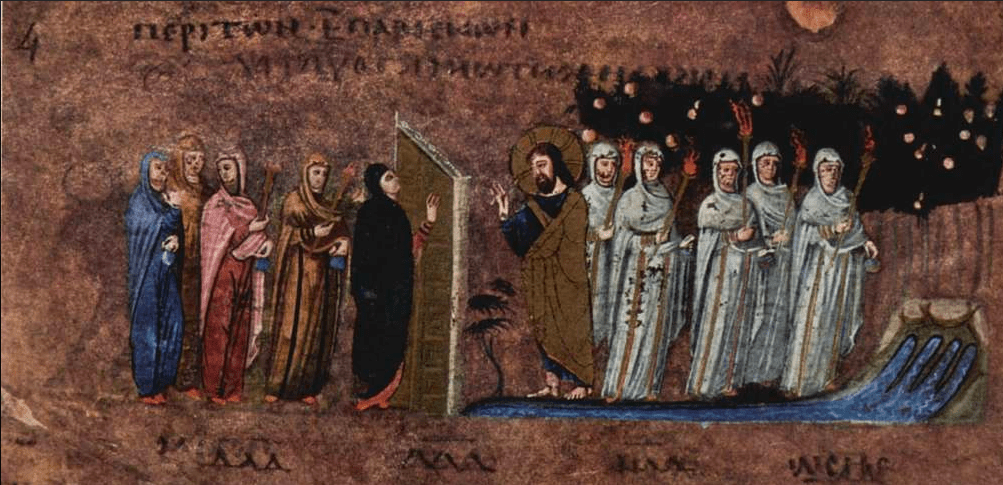
1 ‘Then the kingdom of heaven will be like this. Ten bridesmaids took their lamps and went to meet the bridegroom.
First of all, this is probably the title, not a part of the narrative. Otherwise, how can you read verse 6? This might not seem like the most exciting place to start, but the whole of the narrative becomes clearer if you read on from here as if said, “Hey, the kingdom of heaven is going to be like that movie ‘Bridesmaids 10!’ You know, the one where they all take their torches out to meet the groom!”
2 Five of them were foolish, and five were wise. 3 When the foolish took their lamps, they took no oil with them; 4 but the wise took flasks of oil with their lamps.
Notice I said torches, not lamps, and not just because I think that’s what Kristen Wiig would use in Bridesmaids 10. Λαμπάδας, which sounds like and is usually translated as “lamp,” probably means “torch.” Again, this helps with the understanding of what Jesus is telling us here. Imagine a torch, either wrapped in a rag dipped in oil or with an oil vessel at the top with a wick. It burns brightly. Great for a party! But it burns quickly. To not have extra oil is foolish.
5 As the bridegroom was delayed, all of them became drowsy and slept.
They all fall asleep. Wise and foolish. Some say this is death, some say it’s the distractions of life. Either way, I am grateful for the equality of this sleep. None of us can be expected to stay entirely awake.
6 But at midnight there was a shout, “Look! Here is the bridegroom! Come out to meet him.” 7 Then all those bridesmaids got up and trimmed their lamps. 8 The foolish said to the wise, “Give us some of your oil, for our lamps are going out.” 9 But the wise replied, “No! there will not be enough for you and for us; you had better go to the dealers and buy some for yourselves.”
There are some things that cannot wait. Some things that cannot be borrowed. As Calvin tells us, “There once was a time for buying, which you ought not to have neglected; for oil was at that time offered for sale, but the means of obtaining it are now withdrawn.” What is the precious oil that keeps the torches of these wise women burning? How have they lived their lives to be ready for this point. Diodati offers that “it is not sufficient for us to be once prepared and disposed to follow Jesus Christ,” as the foolish in this story did, burning quickly and brightly. We must “also persevere in it.” These women are “true believers that are provided in their hearts with instructions in faith and piety, and the gift of the spirit, which is the oil that burns…the lamps are their hearts.” As Latimer puts it “the oil is faith in Christ, which if you lack, then all things are unsavory before the face of God.” There are some things that cannot wait. Some things that cannot be borrowed.
10 And while they went to buy it, the bridegroom came, and those who were ready went with him into the wedding banquet; and the door was shut.
It seems that now, whether or not they have the oil doesn’t matter, but I am curious where they went. What could they have done to obtain more of this oil? Writing in something of a different spirit than the reformers, Chrysostom asks “who are they that sell oil? The poor. Do you see what great profit arises to us from the poor? Should you take them away, you would take away the great hope of our salvation. Wherefore here must we get together the oil, that it may be useful to us there, when the time calls us. For that is not the time of collecting it, but this. Spend not then your goods for nought in luxury and vainglory. For you will have need of much oil there.” Where Calvin and Chrysostom agree is that there is a time for readiness. You must receive, by faith, what Christ has to offer.
11 Later the other bridesmaids came also, saying, “Lord, lord, open to us.” 12 But he replied, “Truly I tell you, I do not know you.”
Hardly the way of addressing a wedding host, or wedding guest for that matter!
13 Keep awake therefore, for you know neither the day nor the hour.
When I arrived at church the Sunday this Gospel was read, I had the rare opportunity to not be scheduled for any particular ministry. I’m a member of an ecumenical community in residence at the Cathedral, but often don’t get to experience the services from the point of view of a member of the cohort, as I vest as an acolyte and sit with the ministers, rather than in the community’s vestments and with the community. I was very much looking forward to joining my siblings for worship. I was ready.
As soon as I walked into the church the liturgy team told me they were down a person and needed my help. What’s more, instead of one of my usual more “interesting” tasks (thurifer, lector, etc.), they asked me to carry a torch (one of large, oil-filled candles carried in and out on either side of the cross) something I would, uncharitably, associate with more junior acolytes. I said yes of course, and privately mourned another Sunday not sitting with my siblings.
What I had begrudgingly accepted became a great gift. In listening to the gospel and the sermon, I considered that I had not, in fact, been ready for worship at all. I had not come willing to be taken where God needed me to go, in big ways and in little. I thought about whether or not I held too tightly to convictions, and if I left enough room for the Holy Spirit’s action in my life. Waling out, despite the plentiful oil in my torch, I knew that I had been one of the foolish bridesmaids.
That Sunday also happened to be Diwali, and two of my colleagues at work were celebrating and had taught me that it’s celebrated by lighting oil lamps called “diyas.” The festival represents the victory of light over darkness and is associated with various deities, including one a coworker of mine is particularly devoted to, Ganesh, the destroyer of obstacles.
What a gift the oil in my torch was that Sunday morning! What a gift to receive it. Like faith, a gift I could only receive. I hope its light will continue to destroy obstacles to readiness in my life and make me ready to walk with Jesus and know the Holy Spirit at work in my life.
 Neil Douglas Reilly
Leave a comment