Matthew 17:1-9
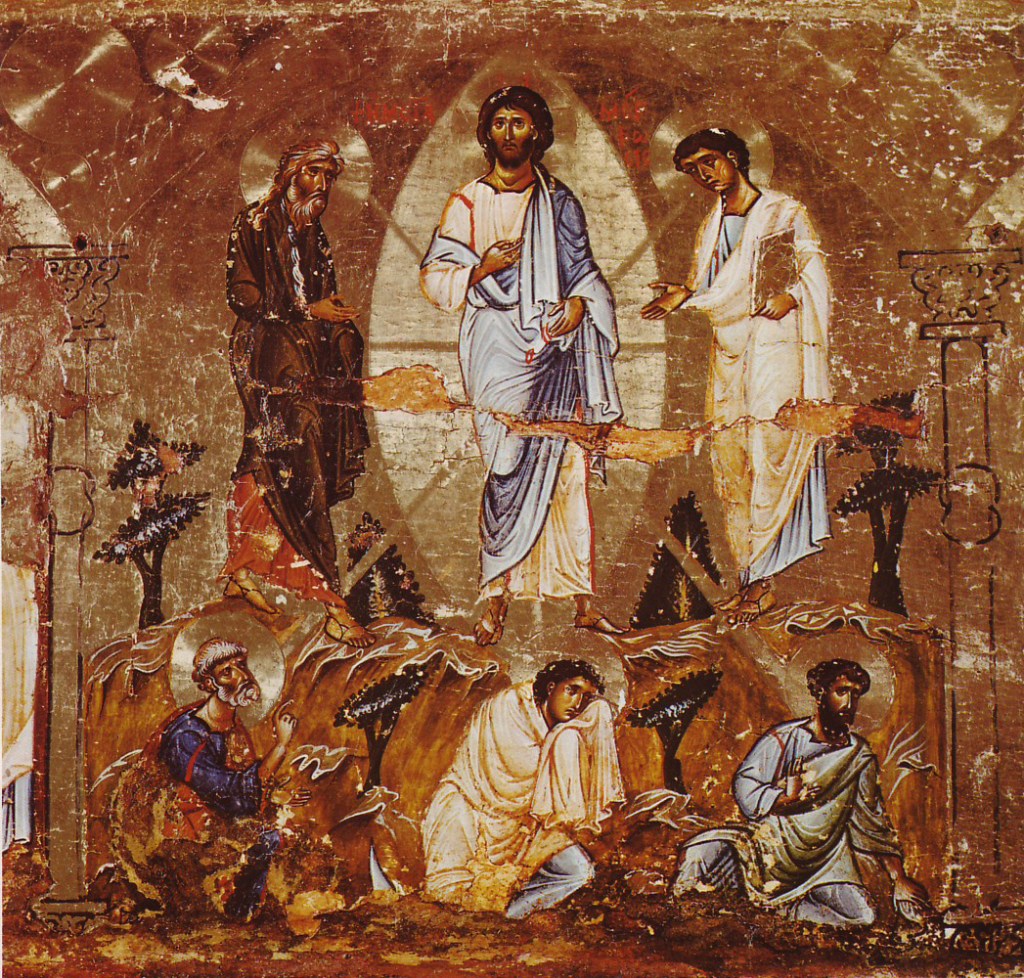
1 Six days later, Jesus took with him Peter and James and his brother John and led them up a high mountain, by themselves.
Immediately before this, the author of Matthew shows us Jesus asking us who Jesus is. Peter has said “You are the Messiah, the Son of the living God,”1 and so Christ says Peter is blessed by God with this understanding, and that he will build his Church on the rock of Peter. However when Jesus goes on to explain that he must suffer and die to accomplish his task, Peter is horrified. Jesus rebukes Peter, recalling his rebuke of Satan himself2 in 4:10, for “setting his mind not on divine things but on human things,”3 and reminds him that self denial and the cross are the path to Kingdom.4
Six days later, Jesus takes Peter, James and John aside and leads them up the mountain.
2 And he was transfigured5 before them, and his face shone like the sun, and his clothes became dazzling white.
Though stunning and beyond his wildest imagination, this scene is doubtlessly familiar to Peter. He would have been instantly reminded of Exodus 24 and Exodus 34: Moses climbing up the mountain, receiving the Law and returning with “the skin of his face shining because he had been talking with God.”6 He knew what came next–Moses told the people of Israel to build a tabernacle for the Law, and they did! 7
In the story in Exodus, the Israelites (and even Aaron!) were not permitted to climb the mountain themselves.8 In fact three specific people are mentioned, Joshua, Aaron and Hur, just as there are three disciples on this journey, but all stayed in various spots down the mountain side. In that circumstance, it is clear that God’s Law will be mediated through Moses to the people, they will not hear God themselves. Even Moses’s authority is mediated through Aaron and Hur, as Moses says that “whoever has a dispute may go to them” while Moses is on the Mountain.9 But now Peter, James and John have made the full journey to the top of the Mountain with Jesus. They are in direct contact with this event.
3 Suddenly there appeared to them Moses and Elijah, talking with him.
As if the setting was not familiar enough, Moses himself is here. Jesus, who earlier in the Gospel said his followers should “not think that I have come to abolish the law or the prophets,”10 but rather fulfill them, is now flanked by them, two great men who also met God on mountain tops. 11
“Moses was called the Law-giver, and Elijiah was the Law restorer; now the Jews traduced CHRIST for a Law-breaker…Moses that brought the Law, and Elijiah that revived the Law, witnessed that he was obedient to the Law. They meet that brought the Law, with CHRIST that brought the Gospel; to show that Law and Gospel must be joined together.”12
– Thomas Adams
Elijah and Moses hold an important eschatological place in the Jewish mindset. The people of Israel were promised a new prophet like Moses,13 and Elijiah was promised as the forerunner of the Messiah. The manner of Moses’ death (and if he died at all!)14 and Elijiah being taken up into heaven15 gives them a special place, as well.
At the beginning of the Gospel, the Author of Matthew spent a great deal of time convincing us that Jesus was “the son of David, the son of Abraham.”16 Why then, is it not Abraham and David at his side on the mountain top?17 Perhaps it is that Moses and Elijah as Law and Prophets and apocalyptic figures was more important. But that is a reason why Moses and Elijiah, not why not Abraham and David. If I were to posit one (beyond that perhaps the author of Matthew may have felt that the first chapter of the Gospel well enough established Jesus as Son of David and Son of Abraham) I would look to what kind of Messiah Jesus describes himself as in Matthew 16. Jesus is going “to Jerusalem and undergo great suffering at the hands of the elders and chief priests and scribes, and be killed,”18 a juridical death, ordered by the state. Moreover, he tells his disciples “if any want to become my followers, let them deny themselves and take up their cross and follow me.”19 The cross – the lynching of the time – a symbol of Roman oppression and execution. His is not a restoration of David’s kingdom, with glorious armies and a king on a throne. And his Gospel and his grace is not restricted only to the sons of Abraham, a single ethnic group.
4 Then Peter said to Jesus, ‘Lord, it is good for us to be here;
Peter responds to this vision with “the words of a man in rapture!”20 How remarkable that Peter is here to witness this sight, something he has always imagined as a source of Law and God’s sovereignty on earth, and so he exclaims “Lord, it is good for us to be here.”
Influenced, I think, by the fact that the other two synoptic Gospels describe Peter as unsure of what he was saying, most commentaries I have read explain away this first remark and move on quickly to deal with what’s wrong with Peter’s next statement, but I think this first statement deserves attention, particularly because one of the only significant differences in the Transfiguration narrative in the synoptic Gospels is that Matthew does not provide this editorial remark about Peter.
Peter understands that he is close to something marvelous, and he is in rapture. He knows that this is the mirror image of the moment his people received their covenant with God, and he knows that it is good to be there. God is close to him, and that is good. Perhaps, even at this stage, Peter, who just six days earlier had said that Jesus is the “Messiah, the Son of the living God,”21 also recognizes that he and James and John are not only going further than Joshua, Aaron and Hur, they are having the experience of Moses–whose face shown because he was face to face with the living God. 22
If you wish, I will make three dwellings here, one for you, one for Moses, and one for Elijah.’
But yes, in his rapture Peter misses something. He forgets that he has already heard Jesus speak with the authority of the Law (you have heard it said… but I say to you)23 and he has already seen Jesus fulfill so many of the words of the prophets. 24
There will be no tabernacle to hold the Law and the Prophets. There is no need to build a temple here, for “something greater than the temple is here,”25 and that builder is greater than any man could hope to be, for, “see, something greater than Solomon is here!”26 Jesus is the living Word, tabernacled among us already. 27 That word will not be kept on a mountain top. The Law that returns from this mountain will be “written not with ink but with the Spirit of the living God, not on tablets of stone but on tablets of human hearts.”28 Perhaps we can see some echo of Peter’s knowledge of the goodness of being close to God even in the suggestion that he build the tents for “he says three, not six: because the apostles desired to be with their Master,”29 or at least to wait upon him.
Consider also that Matthew’s Gospel is written after the destruction of the temple in Jerusalem in 70 CE. A physical place with a physical law has been lost. This puts Peter’s suggestion, and the rebuke of the heavenly voice, in a new light, particularly considering the potential tensions between a new, non-temple-centric Judaism that focused around the Synagogues that would have been emerging at the time of the Gospel’s creation. These Jewish peoples may well have been in conflict with Christian communities, including Matthew’s.
5 While he was still speaking, suddenly a bright cloud 30overshadowed them, and from the cloud a voice said, ‘This is my Son, the Beloved; with him I am well pleased; listen to him!’
The voice of God gives answer to Peter’s suggestion with a particular singularity–Jesus is God’s own son, listen to him. In this answer, God not only rebukes Peter (lovingly), but gives a command to the whole of the Church, that we might see Christ, his only son, as the
“supreme and only teacher of his Church. It was his design to distinguish Christ from all the rest, as we truly and strictly infer from those words, that by nature he was God’s only Son In like manner, we learn that he alone is beloved by the Father, and that he alone is appointed to be our Teacher, that in him all authority may dwell…on his mouth alone it may depend.”31
– John Calvin
Peter had fallen back on his mistakes of the last chapter. He sees that Jesus is God in Christ, God close to us, but he wants to skip the self-denial and the cross, he wants to stay on the mountain of the transfiguration and put aside the cross and the hill of Golgotha. I think we can all relate.
“Come down, Peter: you were desiring to rest on the mount; come down, preach the word…Endure, labour hard, bear your measure of torture; that you may possess what is meant by the white raiment of the Lord, through the brightness and the beauty of an upright laboring in charity.”32
– Augustine of Hippo
The overshadowing cloud and the voice announcing an arrival nods towards a coronation, a theme in the Gospel of Matthew I am very interested in.
6 When the disciples heard this, they fell to the ground and were overcome by fear. 7 But Jesus came and touched them, saying, ‘Get up and do not be afraid.’
And here the second major difference between the synoptic retellings. Only Matthew has Christ come and touch the disciples, help them up, and speak these words to them: ‘Get up and do not be afraid.’
“Observe, after they had an express command from heaven to hear Christ, the first word they had from him was, ‘Be not afraid,’ hear that.”33
– Matthew Henry
Jesus responds to their fear, meets them where they are. Jesus is the incarnate tabernacle of the word, and filled with concern for his friends, he comes and he touches them, a material act dealing with the material conditions that impede their ability to experience God’s love.
8 And when they looked up, they saw no one except Jesus himself alone.
Again, it is only Jesus. For the Church, Jesus is the light by which everything must be seen. After the resurrection “Moses will be there; but now no more the Law. We shall see Elijah there too; but now no more the Prophet. For the Law and the Prophets have only given witness to Christ.” 34
What does that mean for Christians and the Law? Are we free from it?
In the letter to the Romans, Paul tells us that “apart from the law sin lies dead. I was once alive apart from the law, but when the commandment came, sin revived and I died, and the very commandment that promised life proved to be death to me. For sin, seizing an opportunity in the commandment, deceived me and through it killed me.”35
That’s how the law always is. Law of the kind written on tablets cannot exist without sin, and it cannot help but to promulgate sin. Lawmaking and law-preserving has always required violence. Law is the result of that violence, and that same violence is the result of the Law. That is why Paul tells us that it is the knowledge of sin, not the knowledge of righteousness, that we gain from the Law.36
Only a New Law, a Fulfilled Law, and a New Divine Sovereignty can break that cycle, what Matthew calls the Kingdom of God37 and what Walter Benjamin refers to as “Divine Violence,” destroying the monopoly the state has on violence, and reaffirming true justice in the place of the Law.38 That Divine Violence is what Jesus has set his face towards in his march to Jerusalem, the act in which he will be both the sovereign and the sacrificed.
What then for us, who seek to “change our hearts” in response to the coming of this Kingdom?
“There is a double obligation of the Law: the obligation of penalty, and the obligation of duty. We are freed from the obligation of penalty, but not from the obligation of duty. He has taken from the Law all power to condemn us, but not all power to rule us. We must still serve God according to his Law, or he will save us according to his Gospel. Our faith in the Lord JESUS, and our obedience to the Law, must be joined together: as Moses and CHRIST met upon the mountain.”39
– Thomas Adams
The obligation, grace, is great. When Moses came down the mountain, he hid his shining face after he spoke, either to hide the fading of the glory or to protect the people of Israel from the brightness.40 But we cannot hide from the obligation Christ lays upon us. We ARE the body of Christ and must meet that obligation directly.
“And all of us, with unveiled faces, seeing the glory of the Lord as though reflected in a mirror, are being transformed into the same image from one degree of glory to another; for this comes from the Lord, the Spirit.” 41
9 As they were coming down the mountain, Jesus ordered them, ‘Tell no one about the vision until after the Son of Man has been raised from the dead.’
They come down the mountain now, heading towards Jerusalem and towards Golgotha. It is useful to consider, as many commentaries do, that there is a link between the mountain and the hill.42 Consider Peter; In rapture and ready on one, afraid, denying and ashamed in another. Consider Christ; flanked by Prophets on one, and by criminals on another. Consider his clothes; shining white and stripped away. Consider the declaration we hear in both places; the Voice of God the Father in one a pagan soldier in another, “this truly was God’s son.” But consider that there are not differences, but commonalities. Disciples are imperfect. Christ’s glorious, blessed robes are his poverty. Christ’s authority is universal. The throne is the cross. In the meeting of these apparent opposites in that crossing, two different things create a new third thing, what Jung called the transcendent function. The truest transformation in the story of the transfiguration doesn’t happen on the mountain, it happens in the choice to go down the mountain, that is the “metanoeite,” the change of heart.
- Mt 16:17 ↩︎
- Mt 4:10, “Jesus said to him, ‘Away with you, Satan!’”
↩︎ - Mt 16:23
↩︎ - Mt 16:24
↩︎ - καὶ μετεμορφώθη ἔμπροσθεν αὐτῶν (Kai metamosohothe empsosten auton). The root is μεταμορφόω (metamorphoó), to transform. Meta: change, morphoo: form. Meta, here, the same as the the first half of μετανοεῖτε (Metanoete), where νοεῖτε can mean “understanding.” So where μετανοεῖτε means to radically change one’s view point, μεταμορφόω means to change one’s form. This word for transfigure is used by Paul in 2 Corinthians 3:18: “And all of us, with unveiled faces, seeing the glory of the Lord as though reflected in a mirror, are being transformed into the same image from one degree of glory to another.” See notes on Collect for Epiphany last. ↩︎
- Exodus 34:29 ↩︎
- Exodus 35:4 ↩︎
- Exodus 24:2 “Moses alone shall come near the Lord; but the others shall not come near, and the people shall not come up with him” ↩︎
- Exodus 24:14 ↩︎
- Mt 5:17
↩︎ - Moses on Mt. Sinia in Exodus 24, Elijah on Mt. Horeb in 1 Kings 19:11-13
↩︎ - Thomas Adams, Commentary on Second Letter of Peter ↩︎
- Deut 18:15-19 ↩︎
- Deut 34:6
↩︎ - 2 Kings 2:1-12 ↩︎
- Mt 1:1
↩︎ - Thomas Adams, in his Commentary on Second Peter cited above, asks “Why did Moses and Elijiah appear, rather than David and Abraham, from whose loins CHRIST JESUS came and who were so famous among the people?” His answer expounds on the affirmative reasons for Moses and Elijiah as receiver and restorer of Law and Prophets.
↩︎ - Mt 16:21 ↩︎
- Mt 16:24 ↩︎
- Giovanni Diodatti, Pious Annotations
↩︎ - Mt 16:16 ↩︎
- Ex 34:29-30 “29 Moses came down from Mount Sinai. As he came down from the mountain with the two tablets of the covenant in his hand, Moses did not know that the skin of his face shone because he had been talking with God. 30 When Aaron and all the Israelites saw Moses, the skin of his face was shining, and they were afraid to come near him.”
↩︎ - For example, Mt 5:21-22 “‘You have heard that it was said to those of ancient times, “You shall not murder” … But I say to you that if you are angry with a brother or sister, you will be liable to judgment.”
↩︎ - For example, Mt 4:14 “so that what had been spoken through the prophet Isaiah might be fulfilled”
↩︎ - Mt 12:6 ↩︎
- Mt 12:42 ↩︎
- John 1:14, “And the Word became flesh and lived among us” uses σκηνόω (skénoó), to have one’s tent or to dwell. The author of Matthew says that Peter wants to build σκηνή (skéné), a tent, booth or tabernacle.
↩︎ - 2 Cor 3:3
↩︎ - John Wesley’s Notes on the Whole Bible
↩︎ - Augustine, in Sermon 28, remarks that the cloud is a sort of single tabernacle (“As the cloud then overshadowed them, and in a way made one tabernacle for them), Calvin, in Harmony of the Gospels, calls it a “bridle.”
↩︎ - Calvin, Harmony of the Gospels
↩︎ - Augustine of Hippo, Sermon 28 ↩︎
- Matthew Henry Commentary on the Whole Bible ↩︎
- Augustine of Hippo, Sermon 28
↩︎ - Romans 7:9-11
↩︎ - Romans 3:20, “for through the law comes the knowledge of sin” – See Peter Vermigli’s treatise on Law.
↩︎ - Mt 16:28 “Truly I tell you, there are some standing here who will not taste death before they see the Son of Man coming in his kingdom,” six days before the Transfiguration, Jesus promised that some of the Disciples (Peter, James and John?) that they would see the coming of this Kingdom. This PRESENT understanding of a parousia separate from the last judgment is powerful to me. A coming of the sovereignty of God in Christ separate from the coming of the last judgment.
↩︎ - Benjamin, Towards a Critique of Violence
↩︎ - Thomas Adams, Commentary on Second Peter
↩︎ - Exodus 34:35
↩︎ - 2 Cor 3:18
↩︎ - N. T. Wright, Matthew for Everyone; Davies & Alison
↩︎
 Neil Douglas Reilly
Leave a comment